10/07/2011

BMW 640d Coupe (2012)


BMW 640d Coupe

Now in its third generation, the new BMW 6-Series Coupé takes the luxury 2+2 concept a step further by matching enhanced comfort and elegant design with sporting performance on a even higher level. The BMW 6-Series Coupé features a sweeping coupé roofline while the long bonnet, short over-hangs, set-back passenger compartment with Hofmeister kink, long wheelbase and flat waistline embody the typical proportions of a BMW coupé more than any other model.
Two exceptional BMW turbocharged petrol engines and a twin turbocharged diesel powerplant, a newly developed chassis and a host of class-leading driver assistance technology ensure that the new BMW 6-Series Coupé is full of substance, while interior space and comfort have been enhanced.
Design
The new BMW 6-Series Coupé features a long sweeping bonnet, set-back passenger compartment and flowing roof-line. Its now traditional BMW "shark nose", with a large, forward-slanted BMW kidney grille, broad air intakes, wide, contoured bonnet and muscular wheel arches, allude to the powerful engine beneath. Inspired by the movement of water, the fluid lines of the car combine with the subtly curved surfaces to create a look of athletic elegance, which together with the 74mm increase in length and 5mm lower height creates a powerful stance.
Character lines stretching the full length of the body define the side view of the BMW 6-Series Coupé. The long, flat bonnet elongates the silhouette while the roof sweeps down in one fluid line, combining with the main body effortlessly, in an elegant coupé fashion, while the frameless doors and chrome side window border emphasise the tight lines of the typically BMW Hofmeister kink.
 

From the rear, bulging wheel arches and horizontal lines highlight the wide track of the new BMW 6-Series Coupé, alluding to its sporting performance and impressive road holding. Two-part rear light clusters give the typical BMW L-shape lights a particularly sporty, dynamic edge. Inside the units, two LED-powered light strips create a striking night-time look. The rear indicators and brake lights also use LED units.
Longer, lower and wider, the new car is larger in every dimension than its predecessor except height, where it now stands half a centimetre closer to the ground. At 4,894mm in length, the new model is 74mm longer than its predecessor, while the wheelbase has stretched similarly, to 2,855mm. The car has also grown by 39mm in width, and now measures 1,894mm across, while 5mm have been shaved off its height.
As standard the new BMW 6-Series Coupé is equipped with xenon headlights that have BMW's familiar double corona look while high-quality chrome elements, such as the fog lamps consisting of a string of three LED units, on the outer edges of the front apron accentuate the width of the car.
Optional Adaptive LED Headlights are available for the first time and provide a bright white light, similar to natural daylight, with low beam and high beam LED light rings. Horizontal LED ribs are positioned in the centre of the light rings ensuring BMW's hallmark twin round headlight look is expressed in a strikingly fresh way. More than just style over substance, the Adaptive LED lights automatically pivot and adjust to the line of the corner depending on the car's speed, steering angle and yaw rate to provide the best visibility possible for the driver.
The interior: made to measure luxury for four
Despite its lower height, the new 2+2 BMW 6-Series Coupé offers greater headroom in both the front and the rear, and height adjustment of the driver and front passenger seats now cover a greater range too. The individual rear sets also provide passengers with additional shoulder and elbow room, making for more comfortable cruising.
The front passenger area is bordered by a surface curving elegantly from the armrest over the side edge of the centre console, upwards and outwards into the instrument panel and then horizontally into the door trim, surrounding the front passenger area with a feeling of exclusive security.
In tune with the rest of the car's optimised performance and greater comfort, the new BMW 6-Series Coupé is fitted with newly developed lightweight seats with an integrated seatbelt system and Easy Entry function to the rear passenger compartment: a brief tap of a switch automatically moves the seat as far forward as possible. Sports seats and Comfort seats can be fitted as an option too. The boot can accommodate 460 litres of luggage, equivalent to three 46-inch golf bags or two medium hard-shell cases and a flight case. To utilise the rear space further the rear seats can be specified with a through-loading ski hatch, allowing two pairs of skis to be transported with ease.
Drivetrain
The new BMW 6-Series Coupé is available with two petrol engines and one diesel engine: the 650i, 640i and 640d respectively.
The world's sportiest diesel engine is a 3.0-litre twin-turbocharged in-line six-cylinder unit producing 313hp at 4,400rpm and 630Nm of torque from only 1,500rpm with the help of variable geometry turbocharging. The BMW 640d Coupé is capable of accelerating from zero to 62mph in 5.5seconds before topping out at an electronicallylimited top speed of 155mph.
It achieves this performance courtesy of sequential turbochargers, one smaller than the other, that provide a near continuous wave of torque from low revs. A complex arrangement of waste gates in the exhaust ensure the smooth transition from one turbo to another as the revs increase. The BMW 640d Coupé is fitted as standard with an eight-speed automatic transmission with Auto Start-Stop and active air flaps behind the kidney grille. Such engineering expertise is the reason why the model offers rapid performance but can still achieve 51.4mpg on the combined cycle and record CO2 emissions of 145g/km.
The 4.4-litre eight-cylinder engine in the new BMW 650i Coupé is unique in that the brace of turbochargers are positioned in the V-shaped area between the cylinder banks. This design results in more efficient packaging and greater engine efficiency. A maximum 407hp is developed between 5,500 and 6,400rpm, with peak torque of 600Nm available between 1,750 and 4,500rpm.
The new BMW 650i Coupé sprints from zero to 62mph in 4.9 seconds, with a top speed electronically limited to 155mph. For a model of such blistering performance and refinement, it is also extraordinarily efficient, with average combined fuel consumption of 26.6mpg and CO2 emissions of 246g/km.
The six-cylinder in-line engine in the new BMW 640i Coupé uses single turbocharger technology alongside petrol direct injection with VALVETRONIC fully variable valve control. This enables the 3.0-litre unit to develop a maximum 320hp at 5,800rpm and maximum torque of 450Nm between 1,300 and 4,500rpm. This engine propels the BMW 640i Coupé from zero to 62mph in 5.4 seconds and on to an electronically limited top speed of 155 mph.
Perhaps even more remarkable are its efficiency figures. The BMW 640i Coupé achieves 36.2mpg on the combined cycle, while CO2 emissions are only 181g/km, proving that at BMW luxurious sporting performance does not come at the expense of economy. Indeed, this model, like the 640d, is fitted as standard with an automatic transmission that features Auto Start-Stop technology and an automatic active air flap control behind the car's kidney grille for optimum engine performance.
EfficientDynamics
Fuel saving technology called ECO PRO mode is offered on the 6-Series. By a touch of the Drive Dynamic Control button ECO PRO mode tweaks the engine management system, accelerator mapping and gear-shift characteristics to favour a relaxed, lowrevving driving style. At the same time, power usage for electronically operated functions such as climate control is regulated to ensure maximum efficiency. A display on the instrument cluster keeps the driver informed of the levels of energy efficiency being achieved to encourage an economical driving style.
As with all BMWs, the new 6-Series Coupé comes with a raft of BMW EfficientDynamics measures to reduce fuel consumption and emissions. In addition to the features highlighted on the 640i Coupé and 640d Coupé, all models have technology such as Brake Energy Regeneration, Electric Power Steering (EPS), the need-based operation of ancillary components and intelligent lightweight construction to ensure maximum efficiency as standard.
Transmission
An eight-speed Sport automatic gearbox is standard fitment on all three models, and its wide range of ratios offer a perfect balance of muscular, sprinting performance, refined high speed cruising and low speed efficiency.
Chassis
The newly developed chassis of the new BMW 6-Series Coupé comes as standard with Drive Dynamic Control, which allows drivers to choose how responsive they want the gearbox, steering and throttle to be, while the Adaptive Drive system is available as an option with electrically controlled dampers and anti-roll stabilisation.
Both the double wishbone front axle and the integral rear axle are made predominantly from aluminium. The chassis set-up is geared to the requirements of drivers looking for a sporting character, although the dampers also respond sensitively to bumps in the road surface under high lateral acceleration.
In addition to the standard electromechanical power steering, another unique feature in this segment is the optional Integral Active Steering system. This system combines Active Steering for the front axle with a steering rear axle, allowing the steering angle and power assistance to be controlled at both the front and the rear with the help of electric motors. This precisely harmonised system offers extraordinary agility in dynamic driving situations, while allowing for an impressively deft touch around twisty mountain passes and in city traffic.
Pricing and specification including M Sport for the first time
The new BMW 6-Series Coupé comes with the highest ever level of standard specification on a Six. Standard for the 640i Coupé and 640d Coupé are 18-inch light alloy wheels, while the 650i Coupé comes as standard with a 19-inch light alloy wheel. All derivatives feature Dakota leather upholstery, eight-speed Sport automatic transmission, electric seat adjustment with memory, BMW Professional Multimedia Navigation system, Xenon headlights, LED front fog lights and front and rear Park Distance Control to name but a few of the standard specification highlights.
The BMW 6-Series Coupé is now available in M Sport specification. The M Sport package adds the M aerodynamic bodystyling package, 19-inch M light alloy wheels, dark chrome exhaust tailpipes, High-gloss Shadowline exterior trim and black brake callipers. Inside Anthracite headlining, Aluminium Hexagon trim, Sport seats and M Sport multi-function leather rimmed steering wheel are fitted.
At the same time as M Sport and the 640d derivative come to the UK for the Coupé, the 6-Series Convertible can now also be specified with M Sport.
Optional equipment
Includes Surround-view, BMW Night Vision with pedestrian recognition, Parking Assist, Lane Change Warning System, Lane Departure Warning System, Speed Limit Display and, still unique in the segment, Head-up Display.
Most advanced audio system ever to grace a BMW offered
Exclusively developed as an option for the new BMW 6-Series, the Bang & Olufsen High-End Surround Sound System produces an exceptionally natural sound from 16 speakers distributed around the cabin. Jointly developed by the Danish audio specialists and BMW, the superb sound system, comprising of two bass speakers, seven mid-range speakers and seven tweeters, all with individual amplifiers, uses Dirac Dimensions technology to recreate the acoustics of a reference listening room. This allows all passengers to enjoy the same outstanding sound quality regardless of where they are sitting.
In addition a number of other options, exclusive to the premium luxury segment, can be specified such as Surround-view, BMW Night Vision with pedestrian recognition, Parking Assist, Lane Change Warning System, Lane Departure Warning System, and Speed Limit Display. The new BMW 6-Series Coupé is also the only car in its segment to be available with a Head-up Display. The latest generation Head-up Display system uses a broader palette of colours and three-dimensional graphics to create an even sharper image.

10/02/2011

Lamborghini Gallardo LP570-4 Super Trofeo Stradale (2012)


Lamborghini Gallardo LP570-4 Super Trofeo Stradale

Stephan Winkelmann, President and CEO of Automobili Lamborghini S.p.A., has presented at the Volkswagen Group Night in Frankfurt the most extreme Gallardo ever: the Lamborghini Gallardo LP570-4 Super Trofeo Stradale. Automobili Lamborghini is bringing motor racing excitement directly to the road. This new and most extreme top model in the Gallardo lineup is based on the successful race car from the Lamborghini Blancpain Super Trofeo, the world's fastest singlemake series.
The car will be produced in a limited run of 150 numbered units.
The Lamborghini Blancpain Super Trofeo championship brings professional racers and gentlemen drivers face-to-face in fiercely fought battles on Europe's most challenging racetracks such as Monza, Silverstone and Hockenheim. There are many similarities between the racing and road versions of this super sports car. For example, they both share the same V10 powerplant, which is used in the racing version with no modifications.
An enormous and manually variable rear spoiler for increased dynamic load
Right from first glance, these similarities are even more evident in the new Lamborghini Gallardo LP570-4 Super Trofeo Stradale. In fact, it is equipped with the same rear spoiler that offers greater aerodynamic load - reaching in the best aerodynamic condition 3 times the load of the Gallardo LP560-4 - for increased dynamic stability during tight, high-speed driving. As in the race cars, the rear spoiler can be varied manually in order to let the driver optimize the car's performance according to the track or road characteristics.


Another element taken directly from the racing version is the removable engine hood with quick-release system. Both the spoiler and the hood are of course made of carbon composite material, as are a host of other components on the SuperTrofeo Stradale. Together with aluminum, carbon fiber is the basis behind the extremely lightweight construction of Gallardo's new top model.
Lightweight construction through consistent use of carbon fiber
The Lamborghini Gallardo LP570-4 Super Trofeo Stradale boasts a maximum dry weight of 1340 kilograms. It beats the already lean Gallardo LP560-4 by 70 kilograms, which gives the Gallardo LP570-4 Super Trofeo Stradale a stunning power-toweight ratio of 2.35 kilograms per HP for breathtaking performance. It sprints from 0 to 100 km/h in a mere 3.4 seconds and reaches 200 km/h just 10.4 seconds later. Its forward thrust finally tops out at 320 km/h.
"Rosso Mars" stands for Italy's racing tradition
The Gallardo Super Trofeo Stradale sports a brand new "Rosso Mars" finish that underscores the special connection between ultimate race track performance and Lamborghini's "Italianness". The "Rosso Mars" color symbolizes Italy's traditional racing red, as established at the beginning of last century in motor racing, when the home nations of the competitors were indicated by the color of the paint on the vehicles. Dark green stood for Great Britain, blue was for France, white (and silver later on) represented Germany, white and blu stripes for USA, and red was the color of all race cars from Italy.
Red, black and carbon fiber characterize the exterior
The exterior appearance of the Lamborghini Gallardo LP570-4 Super Trofeo Stradale is perfectly accentuated by a matte black finish on the large rear spoiler, the engine hood and the front air intakes, which contrasts with the "Rosso Mars" paint. The forged wheels are painted in high-gloss black, a color that is also available on the roof as an option. The rocker panel covers, impressive rear diffuser and outside mirror housings are made of carbon fiber polished to a high gloss, while the brake calipers are accented in red for the first time on a Lamborghini. It's a perfect match with the exterior color and racing concept of this new super sports car. And besides the historically suggestive "Rosso Mars", the new Gallardo Super Trofeo Stradale is also available upon request in "Grigio Telesto" or "Bianco Monocerus" with the roof available in gloss black as an option, as mentioned above.
Minimalist sporty interior
Black and red, the perfect combination of sporty minimalism, are the dominant shades inside the Super Trofeo Stradale. The most broadly used materials are Alcantara - in "Rosso Mars" on the underside of the dashboard, the central part of the seat cushion and the backrest - and extremely lightweight carbon fiber. Black Alcantara with contrasting red top-stitching is used to finish the other parts of the interior. The steering wheel is upholstered in black suede and also features red top-stitching. The door panels, the monocoque racing seats and the center console cover are made of carbon fiber, the construction of which Lamborghini has achieved a world-leading expertise. Discreet sporty accents are provided by dark chrome visible metal parts.
Upon request, an interior layout including elements made of carbon fiber, such as the handbrake frame, the middle of the center console, the lower rim of the steering wheel, the decorative frames around the main and secondary instrument panels, the door handles, and the handle for opening the glove box (also available upon request), can be ordered.
Phenomenal powerplant
Like the Super Trofeo competition version, the new Super Trofeo Stradale is based on the Gallardo Superleggera technical approach. The V10 powerplant generates 570 HP, equivalent to 419 kW, which is fully available at 8000 RPM. The maximum torque is equally impressive, with the torque curve peaking at 540 Nm at 6500 RPM. The V10's unique firing order delivers the striking sound you hear in motor racing.
Transmission "race tested" in the Lamborghini Blancpain Super Trofeo championship series
Like the race car, the Gallardo Super Trofeo Stradale offers the robotized egear six-speed transmission controlled by steering wheel paddles as standard equipment. This electronically controlled system shifts through its six gears smoothly and much faster than any human being could. And for maximum acceleration from a standing start, the transmission can be set to the "Thrust Mode" - a program that allows to reach the best performance possible executing a racing start with minimal tire slippage at an initial engine speed of approximately 5000 rpm.
Permanent all-wheel drive for maximum traction in any situation
Every kilometer in the Lamborghini Gallardo LP570-4 Super Trofeo Stradale is packed with sheer excitement, in part due to its unrelenting grip in virtually all situations thanks to all-wheel drive. At the end of the day, the Lamborghini Super Trofeo is the only single-brand racing series in the world that features all-wheel drive race cars. The Gallardo Super Trofeo Stradale is a highly concentrated driving machine offering a truly stunning driving experience with breathtaking cornering speeds and fast, immediate response. Its road manners are always precise, stable and completely safe.
Suspension with unmatched precision
The layout of the suspension is directly derived from motor racing, with a double aluminum wishbone guiding the wheels. Precise rack-and-pinion steering gives the driver a very close connection to the road. As is true for the Gallardo Superleggera, the vehicle is specially set up to take full advantage of its dynamic potential. No other model in the Gallardo line is as close to being a true race car. Another great feature is the ultra-lightweight 19-inch wheels, which alone save some 13 kilograms. The lightweight and sturdy wheel bearings and bolts are made from titanium and high performance Pirelli P Zero Corsa tires are fitted.
Brakes with unmatched stopping power
Behind the massive wheels are brakes designed for unmatched stopping power, as controlled by the ESP stability control system, which is standard equipment. The front axle is equipped with aluminum calipers with eight pistons each, and the calipers on the rear axle have four pistons each. The ventilated discs on the front and rear measure 365 and 356 millimeters, respectively. Upon request, Lamborghini will install a carbon-ceramic brake system. The carbon-ceramic discs measure 380 mm for the front wheels and 356 mm for the rear wheels.
Racing-type options
The optional equipment designed with racing in mind includes not only the carbon-fiber ceramic brake discs, but also a tubular interior roll cage, 4-point safety belts and fire extinguisher. On the other hand, those who want comfort can equip their Super Trofeo Stradale with a satellite navigation, with Bluetooth connection for mobile phones, an anti-theft system, and a lifting system that raises the front axle.
Lamborghini Gallardo LP570-4 Super Trofeo Stradale - Technical Data
  • CHASSIS AND BODY
    • Frame: Structural aluminium space frame, based on aluminium extruded parts welded to cast aluminium joint elements
    • Body: Aluminium with thermoplastic "hang-on" parts and diffuse use of Carbon Fiber
    • Suspension: Double-wishbone front and rear suspension system, anti-roll bar, anti-dive and anti-squat
    • ESP: Full ESP system with ABS, ASR and ABD
    • Steel brakes: Power vacuum, aluminium alloy callipers: 8 cylinder front callipers and 4 cylinder rear callipers
    • Ventilated discs
      • EU: Ø 365 x 34 mm front - Ø 356 x 32 mm rear
      • US : Ø 14.37 x 1.34 front - Ø 14 x 1.26 rear
    • Steering: Power-assisted rack and pinion
    • Tires (front - rear): Pirelli P ZERO CORSA 235/35 ZR 19 - 295/30 ZR 19
    • Wheels (front - rear): Aluminium alloy: 8.5" x Ø 19" - 11" x Ø 19"
    • Kerb-to-kerb turning circle: 11.5 m (37,7 ft)
    • Mirrors: External mirror manually foldable
    • Rear spoiler: Manually variable wing set up
    • Airbags: Front "dual-stage" driver and passenger airbags
  • ENGINE
    • Type: 10 cylinders V 90°, DOHC 4 valves, common-pin crankshaft
    • Displacement: 5204 cc (317,6 cu in)
    • Bore and stroke: Ø 84.5 mm x 92.8 mm (Ø 3,33 in x 3,65 in)
    • Valve gear: Chain-driven, intake and exhaust continuously variable valve timing, electronically controlled
    • Compression ratio: 12,5:1
    • Maximum power: 419 kW (570 CV) at 8000 rpm
    • Maximum torque: 540 Nm at 6500 rpm (398,3 ft lbs at 6500 rpm)
    • Emission class: EURO 5 - LEV 2
    • Emission control system: Catalytic converters with lambda sensors
    • Cooling system: Two water radiators + oil-to-water cooler, engine and gearbox radiator
    • Engine management system: Bosch MED 9
    • Lubrication system: Dry sump
  • DRIVETRAIN
    • Type of transmission: Permanent 4-wheel drive with viscous traction system
    • Gearbox: 6-speed + reverse; Standard robotised sequential e-gear system with actuation by paddles on the steering column
    • Clutch: Double plate, Ø 215 mm (Ø 8,46 in)
  • PERFORMANCE
    • Top speed: 320 km/h (198.8 mph)
    • Acceleration
    • 0-100 km/h [0-62 mph]: 3.4 sec.
    • 0-200 km/h [0-124 mph]: 10.4 sec
  • DIMENSIONS
    • Wheelbase: 2560 mm (100,8 in)
    • Overall length: 4386 mm (172,7 in)
    • Overall width (excluding mirrors): 1900 mm (74,8 in)
    • Overall height: 1165 mm (45,9 in)
    • Track (front - rear): 1632 mm - 1597 mm (64,3 in - 62,9 in)
    • Dry weight: 1340 kg (2954 lb)
    • Weight distribution (front - rear): 43% - 57%
  • TANK CAPACITIES
    • Fuel tank: 90 litres (23,8 US gal)
    • Engine oil: 10 litres (2,6 US gal)
    • Engine coolant: 20 litres (5,3 US gal)
  • CONSUMPTION
    • Urban cycle: 20,4 l/100 km (13 mpg)
    • Extra urban cycle: 9,4 l/100 km (20 mpg)
    • Combined: 13,5 l/100 km (16 mpg)
    • CO2 emission: 319 g/km

Aston Martin Cygnet (2012)


Aston Martin Cygnet

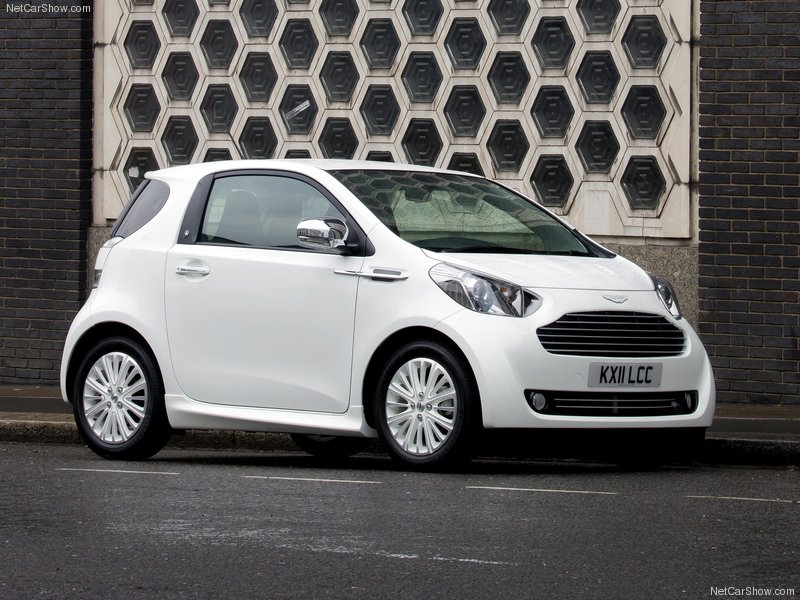
The Aston Martin Cygnet is a city car that sets a new benchmark for compact luxury, building upon nearly a century of experience building high performance sports cars, luxurious long-range grand tourers, and extremely competitive racing machines.
Cygnet demonstrates Aston Martin's commitment to innovation and integrity. "It is time to think differently. Aston Martin is honest and we don't make compromises" says Aston Martin CEO Dr Ulrich Bez.
"Whatever we do, we do right. If we do performance, we do performance; we don't downsize or compromise our sports cars. The Cygnet needs to satisfy the demands of emissions and space. It is a car without compromise, just like every other Aston Martin.
"Our customers need a small car for urban and city use, and they want the right tools for the right job, to downsize creatively without compromising intelligence, artistry and personality."
Aston Martin Cygnet expresses a simple but fundamental idea: in the modern city, scale equates to speed and freedom. At just three metres long, the Cygnet gives the driver a new dimension of freedom, able to slot into gaps in traffic, exploit the smallest parking spaces, consume the least fuel and emit the lowest emissions, all while delivering exceptional levels of quality and comfort


.
"Cygnet is small but luxurious, an Aston Martin tailor fit for the city," says Marek Reichman, Aston Martin's Director of Design. With an almost unlimited palette of materials, colours and textures, each hand-finished Cygnet will be truly unique, a personalised space within the city. "Luxury is not constrained by scale."
Cygnet is a product of Aston Martin's unrivalled experience in craft, technology and design. The future city will present a very different luxury brand landscape, as social change and legislation increases the division between urban and anti-urban product categories. With the Cygnet, Aston Martin will be at the forefront of these changes, ensuring the company's enduring brand image will continue to prosper in new market conditions.
Dr Ulrich Bez continues: "The Cygnet is designed to support our sports cars by providing a greater degree of freedom in the urban context; it is a very special car, a premium but compact package with heart, soul and personality."
The Cygnet, a tailor fit solution for the city, will help drive Aston Martin into the future. "This car is reality; Cygnet is the natural choice for those who want a premium, bespoke commuter car."
The Cygnet will be the eighth major production car Aston Martin has introduced at its state-of-the art factory since 2004, offering further evidence of the company's ongoing commitment to British manufacturing, backed-up by a dedicated local workforce and supplier network.

10/01/2011

BMW 5 ActiveHybrid (2013)


BMW 5 ActiveHybrid

BMW takes the development of intelligent hybrid drive systems to the next level with the introduction of the BMW 5 ActiveHybrid - another series-produced model in which a combustion engine and electric motor join forces to enhance both efficiency and the brand's hallmark driving pleasure. The BMW 5 ActiveHybrid brings together a BMW TwinPower Turbo six-cylinder in-line engine, an electric drive system and an eight-speed automatic gearbox for the first time. The latest generation of BMW ActiveHybrid technology also adds precisely controlled - and therefore extremely effective - energy management to the mix. All of which gives the BMW 5 ActiveHybrid an exceptional balance of performance and fuel economy for the premium executive car class. Its drive system generates combined output of 250 kW/340 hp, allows the car to be driven on electric power alone up to 60 km/h (37 mph), accelerates the BMW 5 ActiveHybrid from 0 to 100 km/h (62 mph) in 5.9 seconds, limits average fuel consumption to between 6.4 and 7.0 litres per 100 kilometres (44 - 40 mpg imp) and has CO2 emissions of just 149 - 163 grams per kilometre (figures according to EU test cycle, may vary according to the tyre format specified).
The 225 kW/306 hp six-cylinder in-line engine with BMW TwinPower Turbo technology in the BMW 5 ActiveHybrid is the same unit renowned for its free-revving capability, pulling power and efficiency in the BMW 535i. The electric motor, meanwhile, develops 40 kW/55 hp and is supplied with energy by a high-performance lithium-ion battery integrated into the luggage area.


A harmonious blend of power from the two drive systems is transferred to the rear wheels by the eight-speed automatic gearbox. In addition to its full-hybrid construction, which enables purely electric and therefore emission-free driving in urban conditions, the BMW 5 ActiveHybrid boasts not only the sportiest performance in its market segment but also a double-digit percentage improvement in fuel economy over the BMW 535i.
In order to fully exploit the potential of the BMW ActiveHybrid technology, the intelligent energy management of the power electronics in the BMW 5 ActiveHybrid uses a host of innovative functions to ensure the drive system runs efficiently. The lithium-ion high-performance battery is charged when the car is coasting or braking, the electric motor performing the role of a generator feeding energy into the high-voltage battery. By contrast, under acceleration the electric motor takes on a boost function. Here, it assists the petrol engine by generating an ultra-dynamic burst of power, lending the sedan's sporty driving experience a noticeably sharper edge. Added to which, while coasting at speeds of up to 160 km/h (100 mph) in ECO PRO mode, the combustion engine can be switched off and fully decoupled. This coasting mode combines comfortable driving with optimum utilisation of the kinetic energy already generated. To avoid periods with the engine running at idle - at junctions or in traffic tailbacks, for example - the BMW 5 ActiveHybrid is equipped with a hybrid start-stop function. Plus, the power electronics in the BMW 5 ActiveHybrid are linked up with the standard-fitted navigation system Professional. This allows forward-looking analysis of the driving situation, enabling the drive components to be primed to deliver maximum efficiency (the effect may vary according to the quality of the available navigation data). All the hybrid-specific components of the drive technology and energy management systems have been developed specially for use in the BMW 5 ActiveHybrid. The result is an extremely well-rounded overall concept, which also provides a convincing demonstration of the BMW ActiveHybrid technology's qualities out on the road. Needless to say, all of the new hybrid components are designed to last for the life of the vehicle.
The BMW 5 ActiveHybrid sees the sporty yet elegant body design of the BMW 5-Series Sedan complemented by bespoke touches which highlight the identity of its drive technology. The "ActiveHybrid 5" lettering on the C-pillars, BMW kidney grille with galvanised slats and exhaust matt chrome tailpipes set the exterior apart from the other models in the range. Available as an option, meanwhile, are 18-inch Streamline light-alloy wheels displaying exceptional aerodynamic efficiency. The BMW 5 ActiveHybrid is the only model in the BMW 5-Series line-up to be available in the exterior paint shade Bluewater metallic, and it also stands out visually from all other 5-Series variants with door sill strips bearing "ActiveHybrid 5" lettering, an aluminium plate on the centre console with the same ID, a bespoke engine cover and the visible "ActiveHybrid Power Unit" inscription on the special casing for the high-performance battery accommodated in the luggage area.
The selection of interior colours, upholstery and interior trim elements reflect the range offered for the other BMW 5-Series Sedan variants. And added to the standard-fitted array of comfort-enhancing features is not only the navigation system Professional, but also a 4-zone climate control system with stationary air conditioning. A wide range of driver assistance systems and BMW ConnectedDrive mobility services, as well as virtually all the other optional extras available for the conventionally powered BMW 5-Series Sedan, can also be specified for the BMW 5 ActiveHybrid.
Innovative combination: award-winning six-cylinder in-line engine, newly developed electric drive system.
This is the first time that a six-cylinder in-line engine has been included as part of a BMW ActiveHybrid system. The 3.0-litre petrol unit, which develops 225 kW/306 hp and peak torque of 400 Newton metres (295 lb-ft), represents a passport to increased driving pleasure and efficiency. The BMW TwinPower Turbo technology of the six-cylinder engine, which has already won the international Engine of the Year Award two years in succession, comprises a twin-scroll turbocharger, High Precision Direct Injection and VALVETRONIC variable valve timing.
The synchronous electric motor of the BMW 5 ActiveHybrid is integrated into the housing of the eight-speed automatic gearbox, saving space. The link-up between the electric motor and gearbox is controlled by a clutch and the motor's operating temperature is regulated by the combustion engine's cooling system. The electric drive system develops 40 kW/55 hp and makes 210 Newton metres (155 lb-ft) of torque available from rest. The motor is supplied with energy by a lithium-ion high-performance battery, likewise specially developed for the BMW 5 ActiveHybrid. The high-voltage battery is encased in a special high-strength housing and positioned between the wheel arches in the luggage area, providing it with optimum protection. It consists of 96 cells, has its own cooling system and offers usable energy capacity of 675 Wh. The integration of the lithium-ion high-performance battery into the luggage area reduces the load capacity of the BMW 5 ActiveHybrid to 375 litres, 145 litres lower than that of a BMW 5-Series Sedan variant powered purely by a combustion engine.
The BMW 5 ActiveHybrid has both a conventional 14-volt power supply and a high-voltage supply with an operating voltage of 317 volts. They are linked up by a voltage transformer ensuring that maximum electric energy can be used to enhance driving dynamics and comfort in any operating phase. Like the electric motor, the air conditioning compressor is also fed with power from the lithium-ion high-performance battery exclusively via the high-voltage supply. This ensures a pleasant interior climate, even when the combustion engine is switched off - i.e. when the car is at a standstill, operating purely on electric power or in coasting mode. In addition, the stationary climate control function can be used to cool the interior before the engine is started up.
Intelligently controlled hybrid technology: unprecedented precision for superior efficiency.
Up to a speed of 60 km/h (37 mph), the BMW 5 ActiveHybrid can operate in all-electric mode for zero emissions in town. The lithium-ion high-voltage battery can store sufficient energy to give an all-electric driving range of up to four kilometres (approx. 2.5 miles) at an average speed of 35 km/h (22 mph).
The internal combustion engine is only started when the driver requires more power: it is then engaged automatically. The electric motor provides a "boost" function to supplement the engine when accelerating. Maximum combined power is 250 kW/340 hp, with maximum torque of 450 Newton metres. Under combined ICE/electric power, the BMW 5 ActiveHybrid delivers a 0 to 100 km/h (62 mph) acceleration time of 5.9 seconds.
Hybrid-specific Auto Start-Stop function and coasting mode.
Thanks to the specially designed Hybrid Auto Start-Stop function, there are no compromises on comfort even when the vehicle is stopped in traffic for longer periods - after the internal combustion engine is shut off, the automatic climate control simply runs off the lithium-ion battery. When the driver releases the brake, the vehicle will restart on either the electric motor alone or the electric motor and the petrol engine, depending on the high-voltage battery's current charge level and on how much power the driver wants.
Another innovation being pioneered in the BMW 5 ActiveHybrid further improves efficiency by shutting the internal combustion engine down not only when the vehicle is stationary, or when driving in town, but also on overrun. In the BMW 5 ActiveHybrid, this coasting mode is available at any speed up to 160 km/h (100 mph). Coasting mode switches off the petrol engine and disconnects it from the drive shaft. From this point on, the BMW 5 ActiveHybrid continues moving soundlessly, with zero emissions and with no engine braking effect. The potential efficiency improvements are further enhanced by tyres with reduced rolling resistance. In coasting mode too, as with all-electric mode for urban driving, all safety and comfort functions remain fully operational.
Intelligent energy management with proactive analysis of the driving situation.
The advanced power electronics coordinate the operation of the internal combustion engine and electric motor with precise reference to the driving situation. For even more efficient energy management in the BMW 5 ActiveHybrid, this functionality has been extended to include proactive analysis of the driving situation. To support this, the power electronics are integrated with the standard-fitted Professional navigation system, which means they can access and analyse data indicating an upcoming change in external conditions or driver requirements at a very early stage. Based on this analysis, the vehicle can be prepared in advance for the relevant requirements so that all powertrain systems and the on-board electronics are managed appropriately and in such a way as to make the most efficient possible use of the available energy.
Factors that may cause a change in powertrain operating strategy include the topography of the route and speed limits. For example, if the system knows that a hilly stretch is coming up soon, the BMW 5 ActiveHybrid can invest all the high-voltage battery's electrical energy in providing supplementary driving power, since the battery will be recharged "at no cost" during the subsequent descent. On longer downhill sections the electric motor's generator function, too, can be enlisted to recharge the high-voltage battery with no loss of speed. The operating strategy can also be managed so as to ensure that the high-voltage battery is as fully charged as possible when nearing the end of the journey, thereby increasing the electric driving range on the "last lap".
The operating status of the powertrain components is shown in intuitive, model-specific displays in the instrument cluster and in the Control Display of the BMW 5 ActiveHybrid. As well as the energy flow and energy recuperation display, these include a further gauge next to the rev counter which shows the boost effect being provided by the electric motor during acceleration. A display in the iDrive interface provides a variety of information - for example on the lithium-ion high-voltage battery's current charge level and the power-sharing between the internal combustion engine and the electric motor in the course of a journey.
Exceptional hybrid model, typical BMW 5-Series: highest standards of driving dynamics, safety and comfort.
The chassis specifications of the BMW 5 ActiveHybrid include a double-wishbone front axle and integral rear axle, electromechanical power steering including the Servotronic speed-sensitive power assist function, a high-performance brake system and 17-inch alloy wheels. Dynamic Damper Control, featuring electronically controlled damping, is optionally available. The Dynamic Stability Control (DSC) system, which stabilises the vehicle by applying braking pressure and reducing engine power, also incorporates functions such as Dynamic Traction Control (DTC), the Anti-lock Braking System (ABS), Cornering Brake Control (CBC), Dynamic Brake Control (DBC), Brake Assist, Fading Compensation, a Dry Braking function and Start-Off Assistant.
The hybrid-specific safety features, which protect the lithium-ion high-voltage battery and the power electronics, are integrated in the BMW 5-Series' elaborate integrated active and passive safety concept. In a collision, high-strength structural components and large deformation zones help to keep impact forces away from the passenger cell and also from the hybrid drive components. Other standard safety systems on the BMW 5 ActiveHybrid include front and side airbags, side curtain head airbags for both rows of seats, three-point inertia-reel belts on all seats, belt force limiters and belt latch tensioners on the front seats and ISOFIX child seat attachments in the rear.
In the BMW 5 ActiveHybrid, too, the standard-fitted Driving Experience Control switch offers not only Sport+, Sport and Comfort set-ups (as well as Comfort+ mode if the optional Dynamic Damper Control is specified), but also ECO PRO mode. The latter supports a particularly relaxed and fuel-efficient driving style, and makes more frequent use of all-electric mode. As an alternative to the standard-fitted automatic transmission, a sports automatic with faster shift times is optionally available.
BMW ConnectedDrive systems optionally available for the BMW 5 ActiveHybrid include Park Distance Control, a rear-view camera, Surround View, Adaptive Headlights, High-Beam Assistant, Speed Limit Info, BMW Parking Assistant, Lane Change Warning, Lane Departure Warning, BMW Night Vision with pedestrian recognition and the BMW Head-Up Display. Innovative technologies also allow in-car integration of the Apple iPhone, other smartphones and music players, and use of the Real-Time Traffic Information and Apps functions.
To further enhance comfort and individuality, the standard-specification 4-zone automatic climate control and navigation system Professional can be supplemented by options such as active seats, active seat ventilation, Comfort Access, the Smart Opener for the tailgate, the Soft Close Automatic function for the doors, a power-operated glass roof and high-end audio and rear entertainment systems.
BMW 5 ActiveHybrid: intelligent technology points the way forward.
The BMW 5 ActiveHybrid features newly developed hybrid components that are combined for the first time with a six-cylinder BMW TwinPower Turbo engine, and innovative functions for further improved efficiency and driving enjoyment. At the same time it broaches yet another market segment, taking BMW's hybrid development work a further step forward. As always, BMW ActiveHybrid technology is offered in a form which is optimally adapted to the requirements of the particular vehicle concept and market segment.

Mercedes-Benz F800 Style Concept (2010)


Mercedes F800 Style Concept

Mercedes-Benz F800 Style Concept is showing the future of premium automobiles from a new perspective, as the five-seat premium sedan combines highly efficient drive technologies with unparalleled safety and convenience features and an emotive design idiom, which interprets current Mercedes-Benz styling in line with the brand's hallmark attribute of refined performance. The F800 Style has a spacious interior full of intelligent seating, operating, and display concepts. Another unique feature of the large sedan is an all-new multi drive platform, which accommodates electric drives with fuel cells (enabling ranges of almost 375 miles) as well as the use of Plug-in Hybrids that can drive for up to 18 miles solely on electricity. Both variants of the Mercedes-Benz F800 Style Concept therefore make locally emission-free mobility possible at the level of a premium-class automobile, while at the same time being fully suited for everyday driving and providing a dynamic driving experience.
"We are dedicated to reconciling our responsibility for the environment with practical customer utility in a fascinating automobile," says Dr. Thomas Weber, the Daimler Board of Management member responsible for Group Research and Mercedes-Benz Cars Development. "The new Mercedes-Benz F800 Style Concept research vehicle combines this commitment to providing the leading innovative drive concepts with our traditional Mercedes strengths in the areas of design, safety, comfort, and outstanding performance."


Within the 15.5-foot external length of the Mercedes F800 Style Concept, all of the components of the vehicle's efficient and environmentally compatible alternative drives (Plug-in Hybrid or fuel cell drive system) are installed in a space-saving manner in the engine compartment and the gaps within the chassis. Each of the drive systems takes up comparatively little space for the installation. This applies in particular to the electric drive with fuel cell, which has been enhanced by Mercedes-Benz to be compact and powerful. The front end's compact package was made possible through the consistent downsizing of all F-CELL components. As a result, the entire interior space is preserved and offers plenty of room for five occupants.
"For many decades now, our research vehicles have been turning pioneering concepts into reality and thereby setting future trends. We set a course on the large touring sedan segment in 2007, when we presented the F700," says Prof. Herbert Kohler, Head of E-Drive & Future Mobility and Chief Environmental Officer at Daimler. "Characteristic features of the Mercedes-Benz F800 Style Concept are its innovations, whose development is already close to the series production stage. This is true not only of the electric drive with fuel cells but also of the Plug-in Hybrid, whose components were taken from our modular system for electric and hybrid vehicles."
Mercedes-Benz F800 Style Concept with Plug-in Hybrid: Outstanding performance despite emissions of only 68 grams CO2 per kilometer
In combination with the very powerful Plug-in Hybrid drive system, the Mercedes F800 Style Concept is a very dynamic expression of the concept of "fascination and responsibility." Its drive unit consists of a V6 gasoline engine with an output of 300 hp with next-generation direct injection and a hybrid module with an output 109 hp so that it delivers a total power of around 409 hp. The lithium-ion battery with a storage capacity of >10 kWh can be recharged either at a charging station or a household power socket. Thanks to its powerful and high-torque hybrid module, in the city the Mercedes-Benz F800 Style Concept can run exclusively on electricity, therefore without generating any local emissions. Because it also has high torque right from the moment it starts, the vehicle has the same driving performance as a car with a V6 gasoline engine even when operating in electric mode. The Mercedes-Benz F800 Style Concept with the Plug-in Hybrid can run purely on electricity for up to 18 miles. The F800 Style research vehicle therefore marks a further important step in the creation of a market-ready Plug-in Hybrid. Mercedes-Benz will begin series production of the S500 Plug-in Hybrid with the introduction of the next-generation S-Class.
Due to its efficient drive system and a CO2 bonus for the battery-electric driving mode, the vehicle has a certified fuel consumption of only 2.9 liters of gasoline per 100 kilometers. This corresponds to extremely low CO2 emissions of only 68 grams per kilometer. However, thanks to its outstanding efficiency, the Mercedes-Benz F800 Style Concept equipped with a Plug-in Hybrid nevertheless has a driving performance comparable to a sports car (0-60 mph 4.7 s, top speed of 155 mph). When in electric mode, the Mercedes-Benz F800 Style Concept has a top speed of 75 mph, thus meeting the needs associated with long-distance driving.
Like the Mercedes-Benz S400 HYBRID introduced in the summer of 2009 and the Vision S500 Plug-in Hybrid, the powerful electric module (approx. 80 kW) of the Mercedes F800 Style Concept is completely integrated into the housing of the seven-speed transmission. The lithium-ion battery in the new research vehicle is located underneath the rear seat, where it takes up little space, creates a low center of gravity, and ensures maximum safety in the event of a crash.
The electric drive components in the Mercedes-Benz F800 Style Concept with the Plug-in Hybrid once again demonstrate the versatility of Mercedes-Benz' extensively scalable modular hybrid system. The hybrid system can be expanded in various ways, depending on performance needs and the area of application. On this basis, it is possible to combine hybrid modules and batteries of different performance ratings with fuel-efficient, high-torque gasoline and diesel engines. Examples range from the current mild hybrids all the way to Plug-in Hybrids that enable pure electric driving over long distances. In developing the Mercedes-Benz F800 Style Concept with Plug-in Hybrid, the Mercedes engineers specifically focused on improving the pure electric driving in urban traffic. Thanks to high power reserves, the F800 Style in e-mode easily masters all kinds of city traffic while producing no local emissions. With the new hybrid module, the top speed of the Mercedes F800 Style Concept with Plug-in Hybrid has been increased to 75 mph in electric mode compared to the Vision S500 Plug-in Hybrid. At the same time, it emits only 68 grams of CO2 per kilometer, compared to the latter vehicle's 74 grams per kilometer.
Flexible, secure, and fully suited to everyday use: The Mercedes-Benz F800 Style Concept with electric drive and fuel cell technology
The F800 Style also offers clean driving pleasure in the variant equipped with an electric drive based on fuel cell technology. The vehicle's electric motor develops around 136 hp as well as a strong torque of approximately 214 lb-ft. The fuel cell generates the traction current by chemically reacting hydrogen with oxygen onboard the vehicle, producing water vapor in the process as the only emission.
The components of the fuel cell drive are taken from the range of available e-drive modules, which Mercedes-Benz developed for a variety of different electric vehicles. These components, which are already installed in the limited edition B-Class F-CELL, can be used flexibly and are suited for a variety of different drive configurations. The Mercedes-Benz F800 Style Concept is an example of this, as it uses rear-wheel drive, in contrast to the B-Class F-CELL. The same components are also installed in commercial vehicles, with developments here being spearheaded by the new Citaro fuel cell bus, which is equipped with two of the F-CELL systems used in passenger cars.
The new Mercedes-Benz research vehicle has the fuel cell located in the front, while the compact electric motor is installed near the rear axle. The lithium-ion battery is located behind the rear seats and is protected as well as possible against the effects of accidents, as are the four hydrogen tanks. Two of the tanks are located in the transmission tunnel between the passengers, while the other two are underneath the rear seat.
Mercedes F800 Style Concept with further innovations for more comfort and safety
In addition to a multi-drive platform that is unparalleled for large sedans and the combination of different alternative drive technologies, the Mercedes-Benz F800 Style Concept features many other technological innovations, such as a new multi-function display concept and a human-machine interface (HMI) with a cam touchpad. The display shows many additional functions not typically found in conventional instrument clusters. The Mercedes-Benz F800 Style's display concept focuses for the first time primarily on electric driving functions.
HMI with cam (camera) touchpad for intuitive and precise operation
The new cam touchpad HMI is an intelligent expansion of the COMAND system. For many years now, Mercedes-Benz has been forging ahead with the development of innovative operating and display systems. A particularly user-friendly innovation is being presented in the Mercedes-Benz F800 Style Concept. The HMI unit here consists of a touchpad on the center console and a camera that records video images of the user's hand as it works the pad. The live image of the hand is presented in transparent form in the central display above the console. The user sees the contours of his or her fingers glide across the image without covering anything, thus ensuring that all of the functions of the currently used menu remain visible so that they can be easily operated by applying slight pressure to the touchpad. Pressing the display with one's fingers generates a feeling similar to that of touching laptop keys so that users know when they are carrying out specific actions.
The cam touchpad HMI unit recognizes finger movements on the pad surface such as wiping, pushing, turning, and zooming, thus enabling intuitive regulation of the climate control system, telephone, stereo and navigation systems, and Internet access. The unit enhances active safety as well, because it is extremely easy and convenient to use and therefore does not distract the driver as much from the actual task of driving. And unlike conventional touchscreens, the HMI cam touchpad does not get smudged with fingerprints.
Conventional touchpad units generally depict hand or finger positions only by a small point in the display. Their lack of precision makes it very risky to enter information while driving, because doing so diverts the motorist's attention too much from the road. By contrast, the HMI with cam touchpad can be easily and safely operated even while driving. Test subjects have confirmed that the HMI with cam touchpad is extremely easy and safe to use, particularly as a result of the transparent depiction of the hand.
Range on Map: Graphic range depiction during electric operation
Another very user-friendly innovation created by the Mercedes engineers is the "Range on Map" function, which shows the remaining possible travel radius during electric vehicle operation as a 360° depiction on a map. Should municipalities only permit purely electric automobile traffic in the future, the driver can determine whether the electric range of his or her vehicle is sufficient for the journey into and out of the urban area by means of the Range on Map function. The system provides this function by combining information on the current battery charge level with data from the navigation system.
In the new operating and display concept, Mercedes-Benz has created a solution that provides an unparalleled amount of information in a system of exemplary clarity. The engineers have thus achieved the goal of successfully developing a comprehensive yet easy-to-operate information and control system for future automobiles equipped with electric or partially electric drive systems. A further-developed version of the system can also display recharging stations.
Mirror display is easy on the eyes
The mirror display of the innovative cam touchpad HMI eliminates the differences between close proximity visibility and visibility over longer distances, thus contributing to the driver's physiological safety in a manner typical of Mercedes. The system displays driving and vehicle information via a mirror in the instrument cluster so that they appear to be farther away. The distance the eye looks into is thus extended, which means less switching between near and far focus — and therefore less fatigue — for the eyes.
New DISTRONIC PLUS Traffic Jam Assistant further reduces the stress of driving
Back in 2006, Mercedes-Benz introduced DISTRONIC PLUS, the world's first proximity and speed control system that operates even when the car is standing still. The system substantially reduces the stress for drivers in dense traffic, as it regulates the distance from the vehicle in front even at very low speeds all the way down to a standstill. With its new DISTRONIC PLUS Traffic Jam Assistant feature in the F800 Style, Mercedes-Benz has also become the world's first automaker to implement a system that is also capable of automatically following the vehicle in front of it into curves. The system recognizes the difference between driving along curving roads and turning, which means it does not "blindly" follow the vehicle up in front — for example, when it changes lanes in order to exit the highway.
The result is that at speeds of up to about 25 mph, the Traffic Jam Assistant function takes care of both longitudinal and transverse movements so that drivers do not have to steer themselves. The driver can just sit back and relax — with hands on the steering wheel. When the 25 mph mark is exceeded, the steering torque that keeps the vehicle in its lane is gradually reduced to a point at which the Traffic Jam Assistant smoothly disengages. Drivers can, of course, override the system at any time. Sensitive sensors notice active steering movements, thus automatically deactivating the system's lateral control function.
"The DISTRONIC PLUS Traffic Jam Assistant is the logical continuation of the Mercedes-Benz assistance and safety philosophy. With it, we are setting another milestone on the path toward creating innovative systems, with which we will further enhance the high driving comfort that is a hallmark of Mercedes," says Prof. Bharat Balasubramanian, Head of Product Innovations & Process Technologies at Group Research and Advanced Engineering. The required data is generated by radar distance sensors that are supplemented by a stereo camera.
PRE-SAFE 360° improves safety in rear-end collisions
While the Traffic Jam Assistant heightens comfort and active safety, the innovative protective system known as PRE-SAFE 360° further improves passive safety. PRE-SAFE 360° is based on the proactive occupant protection system PRE SAFE® developed by Mercedes-Benz. Unlike the previous system, PRE-SAFE 360° also monitors the area behind the vehicle. As a result, the system engages the brakes around 600 milliseconds before an anticipated rear-end collision occurs. The key advantage of this system is that braking a stationary vehicle helps prevent secondary accidents such as those that occur when the car is pushed uncontrolled into an intersection or a pedestrian crossing. It goes without saying that PRE-SAFE 360° also allows the driver to take control at any time. For example, the brake is immediately released if the driver hits the gas pedal, should they recognize that there is sufficient space in front of their vehicle to avoid the rear impact.
Rear pivot-and-slide doors ensure maximum entry comfort
A particularly customer-friendly innovation of the Mercedes-Benz F800 Style Concept is its rear doors. Whereas the front doors are attached to the A-pillar in a conventional manner and open wide toward the front, the rear doors slide backward when opened, as they are suspended from an interior swivel arm. Because the doors slide back close to the vehicle body, occupants find it much easier to get into and out of the automobile in tight parking spaces.
The Mercedes F800 Style Concept also has no B-pillar, making the entire space between the A and C-pillars completely accessible when the doors are opened. Despite the lack of a B-pillar, the Mercedes-Benz F800 Style Concept boasts a bodyshell that is both extremely robust and lightweight, and that meets the stringent demands for crash safety that are a hallmark of the Mercedes brand.
Reinterpretation of the typical Mercedes-Benz design idiom
The Mercedes-Benz F800 Style Concept is both a technology platform and a showcar. This research vehicle was created through close cooperation between technical research and advanced engineering departments and the advanced design studios in Sindelfingen, Germany and Como, Italy. Its exterior appearance is marked by a long wheelbase, short body overhangs, and a sensually flowing roof line.
"The exciting coupe-like roof line, and in general the vehicle's balanced proportions, lend it a stylish sporty look that reinterprets the Mercedes-Benz design idiom and emphasizes the sculptural character of the Mercedes-Benz F800 Style Concept," says Mercedes-Benz Head of Design Prof. Gorden Wagener. "The result is a harmonious blend of innovative form and function, which conveys a sense of great styling and authority."
Front end with distinctive LED headlights
The vehicle's front end features a variation of the radiator grille with the centrally placed star that is typical of Mercedes sports cars. The curved radiator grille bars softly flow around the tube holding the Mercedes-Benz brand star. Along with the wide radiator grille and the generously curved air intake openings, the model's unique bright LED headlights emphasize the dynamic nature of the research vehicle. The headlights are divided into individual segments for daytime running lights, turn signal indicators, and primary headlights. The Mercedes-Benz F800 Style Concept's taillights are also equipped with state-of-the-art LED units that enable an exciting interplay of indirect illumination and direct beams. The result is an attractive, unmistakable, and memorable visual effect.
Wood and light create a cozy interior
Luxurious wood surfaces and lots of light ensure a high level of comfort in the interior of the Mercedes F800 Style Concept. Occupants will immediately notice the modern sense of lightness, and functional elements like the driver area and the door armrests seem to float in space like sculptures. The innovative lightweight-construction seats in the Mercedes-Benz F800 Style Concept consist of a magnesium shell and a carbon fiber laminate shell backed with a fine yet resistant netting. The seat shell also features genuine wood veneer. For the veneer process, Mercedes-Benz engineers used a 3D surface coating procedure designed especially for the veneering of three-dimensional surfaces. This same procedure was used to create the wood finish in the center console, on the doors, and in the driver area. These wood finishing pieces are molded as 3D laminated components and are augmented by an aluminum core, which ensures that the components meet the high crash safety standards that are a hallmark of Mercedes.
Successful transfer from research to series production
Mercedes-Benz has presented 13 research vehicles since the early 1980s. The range of innovative and pioneering automobiles that was unveiled — beginning with Auto 2000 in 1981 and leading up to today's F800 Style — offers proof of the consistency and foresight with which Mercedes-Benz engineers address the core issues of research and technology in order to develop innovative solutions for the future. Many systems that were first used in research vehicles and viewed as revolutionary at the time are now found in Mercedes-Benz production cars, including the DISTRONIC proximity-controlled cruise control, which was first installed in the F 100 in 1991 and made its series production debut in the S-Class in 1998.
The Mercedes-Benz F800 Style Concept is continuing this approach. Like its predecessors, the model features important drive, comfort, and safety system innovations, as well as an avant-garde design, all of which point the way forward for future series- production Mercedes-Benz vehicles that will continue to impressively combine fascination and responsibility.